Why Fully Biodegradable Sanitary Napkins Are a Game Changer for the Environment?
Fully biodegradable sanitary napkin, specifically in the field of sanitary napkin manufacturing.
Background Technology and Current Limitations
Currently, sanitary napkins on the market are designed with non-degradable PE layers for the bottom film, non-degradable ES mesh or PE perforated film for the top layer, and non-degradable PE film for the outer covering. The shortcomings of this design are twofold:
- Due to the non-degradable materials used, sanitary napkins generate waste that cannot decompose naturally, resulting in serious environmental pollution. While users may feel clean and comfortable, the environment is harmed in the process.
- The production cost is high due to the use of non-degradable layered materials.
Invention Purpose
The goal of the design is to avoid the shortcomings of the existing technology by creating a sanitary napkin that can automatically degrade, reducing environmental pollution, and significantly lowering production costs.
Design Plan
To achieve the design objectives, the following structural solutions are proposed:
- Bottom Layer: The fully biodegradable sanitary napkin uses waterproof paper for the bottom layer. The use of waterproof paper is beneficial for several reasons:
- Waterproof paper is significantly cheaper than PE films, thus lowering production costs.
- Waterproof paper effectively prevents water molecules from penetrating for a short period, but once exposed to menstrual fluid, it will slowly decompose, allowing menstrual fluid to permeate and trigger biodegradation.
- It ensures that menstrual fluid does not seep out, as it blocks the fluid initially but allows for gradual penetration over time, leading to the breakdown of the paper.
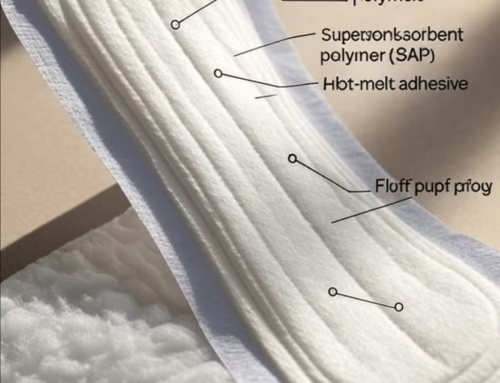
- Absorbent Layer: The absorbent layer consists of sanitary paper, wood pulp, and superabsorbent polymer beads. The reasons for this composition include:
- Wood pulp is more cost-effective than cotton pulp or cotton layers and has excellent moisture-absorbing properties.
- The combination of wood pulp and superabsorbent beads significantly enhances water retention, preventing leakage and overflow of menstrual fluid.
- After disposal, the absorbed menstrual fluid allows for slow permeation through the waterproof paper, triggering a reaction with the paper’s molecular structure to accelerate biodegradation.
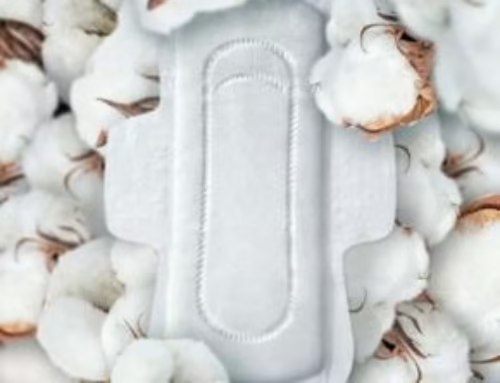
- Top Layer (Nonwoven Fabric): The fully biodegradable napkin uses cotton fiber spunlace nonwoven fabric. This layer is designed for:
- Cotton spunlace nonwoven fabric is gentle on the skin, providing comfort without causing harm, and meeting the physiological needs of the skin.
- The fabric’s microporous structure ensures point-like contact with the skin, facilitating the transfer of menstrual fluid while keeping the skin dry and comfortable.
- Outer Covering: The biodegradable outer cover is made from paper or cotton-based nonwoven fabric. The goal is to ensure that the entire napkin, including its outer film, is fully biodegradable, achieving complete biodegradation of the product.
Technical Solution
The technical solution involves the following design for the fully biodegradable sanitary napkin:
- The absorbent layer is placed on top of the biodegradable waterproof wood pulp paper , while the cotton-based spunlace nonwoven fabric is placed above the absorbent layer.
- The absorbent layer consists of sanitary paper, wood pulp, and superabsorbent polymer beads, with the pulp and beads mixed between two layers of sanitary paper.
- The napkin is designed as a double-wing rectangular shape, with wings attached to the back of the napkin, and release papers applied on the wings’ adhesive strips.
- The back of the napkin has an adhesive strip for easy attachment, with release paper placed on top for convenience.
Advantages Over Existing Technology
Compared to existing technologies, this design offers several advantages:
- The layered design of the absorbent, waterproof, and contact layers ensures effective absorption and prevents leakage. The materials gradually degrade after use, providing environmental protection by allowing the layers to naturally break down over time.
- The production cost is significantly reduced by using cheaper materials like waterproof paper and wood pulp, which fulfill the necessary functional requirements.
Fully Biodegradable Construction
The fully biodegradable sanitary napkin features:
- An absorbent layer on biodegradable waterproof wood pulp paper.
- Cotton-based spunlace nonwoven fabric above the absorbent layer, which is bonded with the waterproof paper.
- The absorbent layer contains sanitary paper, wood pulp, and superabsorbent polymer beads.
- The napkin’s back includes an adhesive strip and release paper, ensuring easy application.
- The napkin is covered with a fully biodegradable membrane made of paper, cotton nonwoven fabric, or non-toxic degradable plastic.
Conclusion
This fully biodegradable sanitary napkin design achieves a sustainable, environmentally friendly solution by ensuring that all layers, including the absorbent, waterproof, and outer layers, are capable of biodegrading naturally. It also reduces production costs while meeting the physiological and psychological needs of users, offering a cleaner, safer, and more eco-friendly product.
| Feature | Material/Component | Purpose/Benefit |
|---|---|---|
| Bottom Layer | Waterproof Paper | Low-cost alternative to PE film, prevents leakage and initiates biodegradation when exposed to menstrual fluid. |
| Absorbent Layer | Sanitary Paper, Wood Pulp, Superabsorbent Polymer Beads | High moisture absorption, prevents leakage, enhances biodegradation. |
| Top Layer | Cotton Fiber Spunlace Nonwoven Fabric | Gentle on skin, ensures comfort, maintains dryness, and promotes fluid transfer. |
| Outer Covering | Paper or Cotton-Based Nonwoven Fabric | Fully biodegradable, ensures complete decomposition of the napkin. |
| Production Cost | Waterproof Paper, Wood Pulp, Cotton Fiber | Reduced production cost compared to conventional non-degradable materials. |
| Biodegradation Process | All Layers (Paper, Wood Pulp, Cotton, etc.) | All components degrade naturally after disposal, reducing environmental pollution. |